No More Flowers
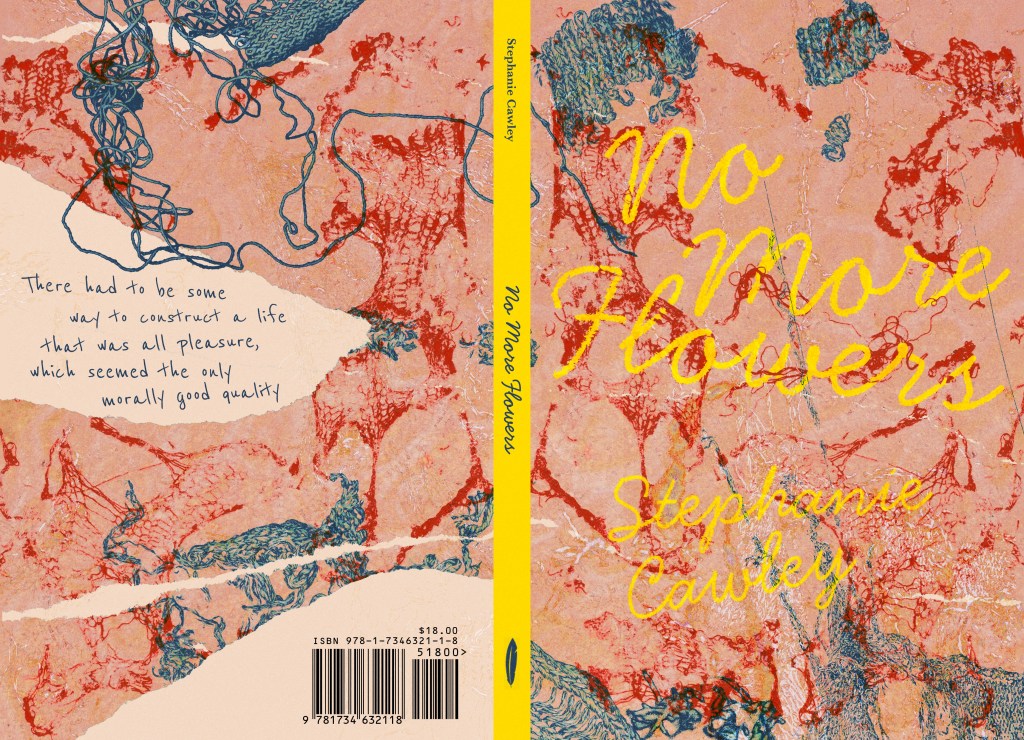
Here are the layers of an exquisite desire, bared to the world, teeth and all. Blood and all. Queer as in: the death of narrative, the death of feeling as an explanatory framework. Long live our pleasures, our unruly beauty rendered illegible by inherited patterns of wanting. Long live the possibility of pleasure as a pathway towards an expansive sense of being, made and unmade at the site of skin against skin. Because we know our arrival is not a point on the horizon, but an endlessly renewable life force within us, between us, for me, for you. “One cannot know what one wants until one knows what wanting is,” Cawley writes — this is a collection of coming into life and living, even in the presence of death. Even in the presence of a void left by diminishments and binaries and a world intent on foreclosures. Reading this book, I came to understand “the future didn’t have to look like anything.
— Kazumi Chin
The journey of these poems had me on the edge of my seat and always on the brink of seeing the world in new ways! “If there was a hole in the center of the forest / I knew I would be dragged into it.” Here is a book we want in our lives, poetry to return to again and again! Stephanie Cawley’s No More Flowers is absolutely brilliant!
— CAConrad
Stephanie Cawley’s No More Flowers is a book that builds soil / earth as viscous porosity. It’s refusal and it’s more generous. It’s a study of entanglement. A collision / a coalescing of memories, thoughts, experiences, edges rustling and shining amongst wildflowers / so close to the highway you can brush against them, pull on a seed. “Life on earth is about applying pressure / without understanding what it might do,” says Cawley. “At this juncture, I unhinge myself from time, gender, cheekbones / How embarrassing, to admit I don’t care about plot, just images of water and a somber face, or, / barring that, a savage, intelligent, feminine interiority,” says Cawley. You bring intentionality to the poem, your life, your politics / and yet / it can still get away from you / get wild.
— Carrie Lorig
I love Stephanie’s mix. It’s been killer for me since day one. Science fiction-y, mundane, dyke, smart, droll, dirty, surprising. As poems they just drop out, in a true 21st century way. This is the path & I’m on it. I say yay.
— Eileen Myles
My Heart But Not My Heart

“Stephanie Cawley’s My Heart But Not My Heart, I want to say, is a book of refusals. The losses and grief that refuse language, the poet’s own refusal of certain performances, the poem’s refusal of expected forms, the speaker’s refusal to slap a manicure on and understand it as self-care, despite the therapist’s best intentions. It is in part about the ways in which our refusals, and our passivity, brought about often by external forces and pressures are then pathologized, medicated, explained away in the dismal language of diagnosis.”
— Solmaz Sharif, from her introduction
“If My Heart But Not My Heart by Stephanie Cawley is a body, it is the sensorium of death’s wake and loss of the beloved. And what do we ask of the body that is to be read, the body that investigates the very materiality of the body’s relationship to being? We ask, perhaps, that when it captures us within the intensity of its feeling, that it also brings us to the ecstatic—a way to stroke suffering. Cawley’s astonishing collection of poetry finds ecstasy where its gorgeous, patient language meets the philosophical. We cannot help but be elevated. ‘Does your tongue get stuck,’ Cawley writes, ‘in the gap between is and was? / There is an actual shrinking.’ Like in Alice Notley’s great monument to loss in ‘At Night the States,’ the hands hold what replaces. The poems’ insistence on the missing text make my knees weak with its persistent and haunting beauty. Stephanie Cawley is an extremely talented new voice, and she’s written a stunning book.”
— Dawn Lundy Martin
“Circuitous in its precision, My Heart But Not My Heart maps the networks that form a body and the networks that a body can make. Stephanie Cawley measures a topography of hurt that is ornate and banal, and therefore very, very true. Every sentence holds an entire forest—vast, historical, traumatic, haunting, seasonally lush and seasonally spare—so masterfully contoured that sky and liquid bend with exquisite and controlled humility.”
—Lily Hoang
Read an excerpt here.
Read an interview here.
A Wilderness
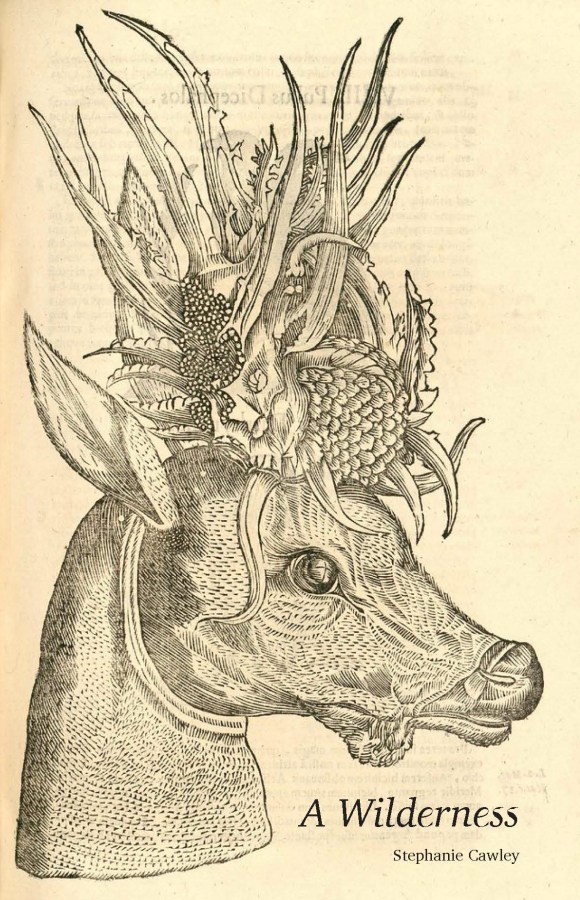
A Wilderness tells us a story about transformation, even as it transforms itself in the chaotic act of telling. Animal, human, flood, wind, trees, gold, stone, language, history—all accumulate in the speaker’s process of becoming: ‘I wanted to be myself, described, not some other form.’ There is a desire to remake, to keep remaking: ‘To edit a seam until it opens.’ I keep wanting to quote lines because the chapbook speaks so well for itself, a point of light that exists despite and amidst tenebrosity: ‘Under the threat of chaos I gleam like a single, wet seed.’ A Wilderness writes in praise of resilience, in acute awareness of terror and disaster, and ranges from gravity to exuberance—ultimately full of the kind of wisdom we want from poetry, the kind that understands the impossibilities life demands and shows us infinite ways to acknowledge them, and keep going.
— Khadijah Queen
Read pieces from A Wilderness here & here & here.
Read an interview here.
 stephanie cawley